


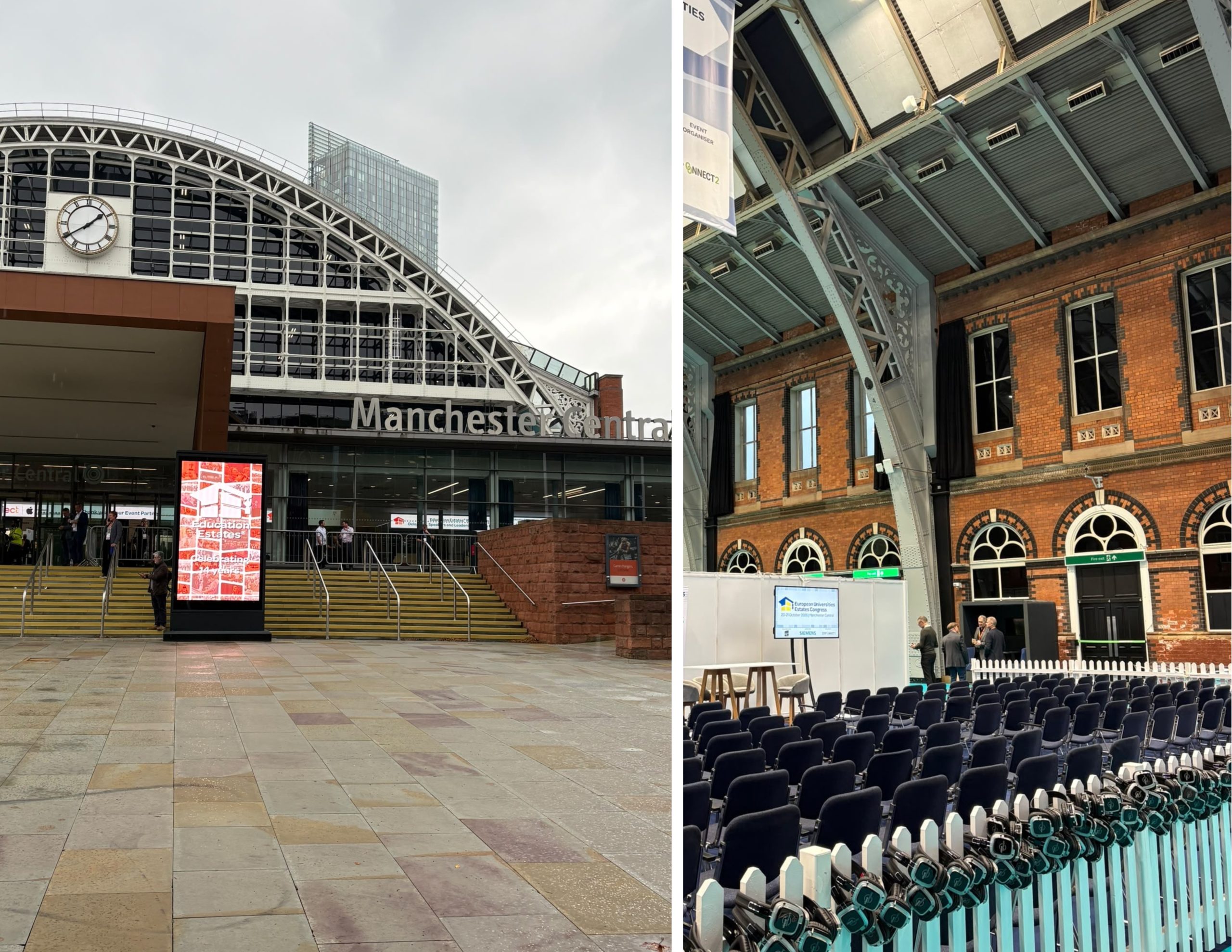

What do these insights from the congress mean for managing educational real estate? We connect lessons from academic research to our own practice through four topics: definitions, objectives, data and monitoring.
Occupancy and utilisation in particular were important topics at the congress. Space that is not being used is, by definition, too expensive. But can you dispose of it? And what does a focus on efficiency actually deliver? Does it contribute to the well-being of students and staff? And hasn’t the COVID-19 pandemic taught us just how important interaction is for students’ learning and research?
Jackie reflects on the congress:
“A quick poll among participants showed that 85% are still exploring the possibilities, and that one of the main barriers is the fragmentation of knowledge and expertise within educational institutions. Who should take the lead: IT or real estate management? Other barriers mentioned included a lack of in-house knowledge and expertise to work with a smart building, as well as data quality.”

Using data to manage educational real estate
 Definitions: be clear about what you measure
 Objectives: what do you want to achieve?
 Data: make use of the information you already have
 Monitoring: data-driven management is not a one-of
Definitions: be clear about what you measure
To manage effectively, you need to know what you want to manage and how you are going to measure it. In educational real estate, we talk about square metres, euros and students. But which square metres do we mean: gross floor area or net floor area? Educational facilities only, or the entire real estate portfolio? And are we talking about operating costs with or without financing costs? Is cleaning included? What about the costs of building management and control systems or sustainability measures?
There are also different categories of students: publicly funded and non-publicly funded students, students in work-based and school-based vocational pathways, lifelong learning participants and students taking microcredentials. Whatever scope you choose, be clear about how students are counted. Do you base this on funding, or on the number of hours they are actually present in the building?
Objectives: what do you want to achieve?
There is a great deal that can be measured, and a great deal is already being measured. But what do you actually want to achieve with those measurements? €/m² and m²/student are commonly used metrics, but what do they really tell you? Expensive square metres may accommodate large numbers of students or contribute to the attractiveness of an institution.
Whatever you measure should be aligned with your ambitions and objectives. We previously asked a large group of real estate managers what they would like to manage for. They mentioned satisfaction, contribution to education and efficient use of space. We then asked what they actually measure: m²/student and €/m² (den Heijer, 2021). In other words, the metrics they use do not provide the insights they actually want.
Data: make use of the information you already have
Many institutions have access to more information than they currently use. Information can be retrieved from different systems and combined. Examples include people counters, access card readers, Wi-Fi connections, building management and control systems, energy monitoring systems and CO₂ measurements. Timetabling systems and FMIS platforms can also provide valuable data.
There is no need to collect information again if it is already available. What is important, however, is connecting the different data sources. This helps prevent errors and duplicate records.
In practice, institutions often use many different data sources, not all of which are equally up to date. There can also be differences in how data is interpreted. As a result, discussions can unnecessarily become focused on issues such as which square metres should or should not be included, walls that have been removed, or spaces being used for activities other than those they were originally designed for.
Monitoring: data-driven management is not a one-off exercise
As an institution, you want your real estate to contribute to your objectives and reflect your organisation’s identity. Every institution has its own goals. Simply copying what another institution does is therefore not necessarily the best choice. Objectives can also conflict with one another. The real estate portfolio of an institution focused on efficiency will look different from that of an institution focused on collaboration with industry. Likewise, customised education and increased flexibility place different demands on a portfolio than innovation and professional expertise.
Indicators become meaningful when you consider how they develop over time (de Vries, 2007). Are you seeing improvement or change? And what do developments in the wider environment or in education itself mean for the way these indicators should be interpreted?
The common thread is clear: measuring more is not the same as managing better. Effective data-driven management requires clear definitions, indicators that align with your objectives, reliable data and attention to developments over time. Only when these elements are considered together do the figures become meaningful for your educational real estate.
Back to the autumn break
“We travelled from Amsterdam to Manchester via Barcelona. We had two days of beautiful weather and four days of rain, two two-hour delays and traffic jams on the way to the airport. We ate local food, went swimming and did plenty of walking. The congress lasted two long, full days, packed with presentations and new connections. Was our autumn break a success? This time it was, because the congress was the reason for the trip. Next year, we’ll take things a little easier and simply stay in the Netherlands.”
References
den Heijer, A. C. (2021). Campus of the future: Managing a matter of solid, liquid and gas. Delft University of Technology.
de Vries, J. C. (2007). Presteren door vastgoed. [Dissertation (TU Delft), Delft University of Technology]. Eburon Academic Publishers.
Een herfstvakantie in Manchester vol nieuwe wetenschappelijke inzichten en studies…
Jackie de Vries
Directeur / Senior adviseur